
Microsoft deploys Maia 200, its homegrown inference accelerator, to take back the cost of AI in Azure
Announced on January 26, 2026 and built on TSMC’s 3nm process, Microsoft’s Maia 200 accelerator is now rolling out across Azure datacenters with 30% better performance per dollar. It is Azure’s bet on homegrown silicon to break its dependence on NVIDIA and OpenAI.
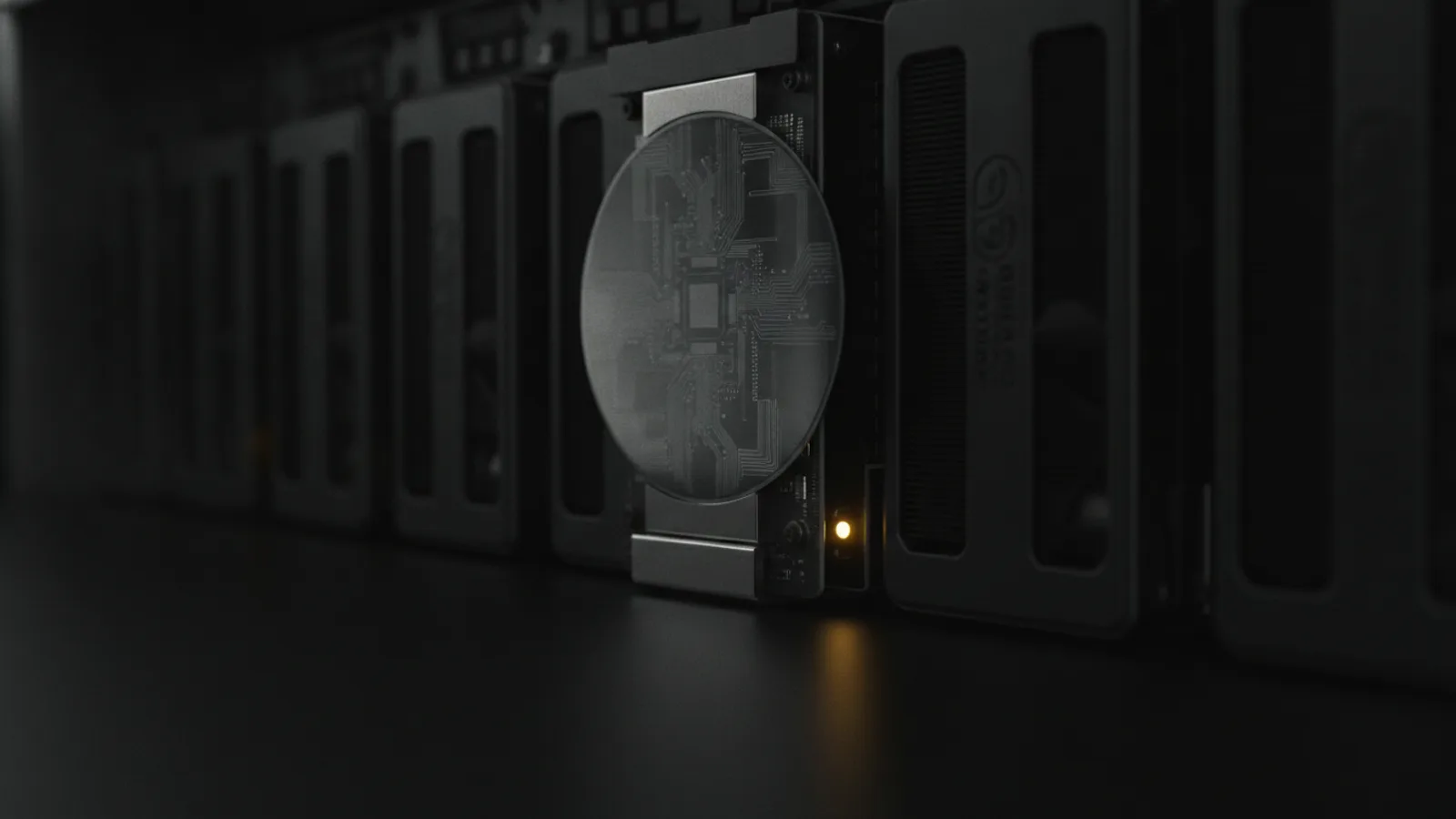
January 26, 2026. Microsoft unveils Maia 200, its second-generation inference accelerator, built on TSMC’s 3nm process. September 2026. The chip enters deployment across Azure datacenters, after a detailed presentation at Hot Chips 2026. Why it matters: a hyperscaler is no longer content to buy GPUs from NVIDIA — it is pushing its own silicon to drive down the cost line that explodes with agents: inference.
A chip built to generate tokens, not to train
Maia 200 is not a training accelerator. Microsoft designed it for inference — producing tokens in response to queries, rather than the heavy, one-off phase of pre-training. The spec sheet is unambiguous: native FP8 and FP4 tensor cores, 216 GB of HBM3e at 7 TB/s, and 272 MB of on-chip SRAM — a memory hierarchy built to serve large models with minimal latency.
The number Microsoft leads with is 30% better performance per dollar over existing systems. For an infrastructure director, the translation is simple: at equal workload, the inference bill drops by roughly a quarter, before any commercial negotiation.
Scott Guthrie, Executive Vice President of Cloud + AI, stresses the system integration: the chip slots into a package that includes the backend network and a second-generation closed-loop liquid cooling system. In other words, Maia 200 is not sold as a standalone part but as a complete rack, calibrated for datacenter availability.
Why inference became the real battleground
For years the race was about training: who could line up the most GPUs to produce the most capable model. But the economics have flipped. A model is trained once; it is then queried billions of times, each request producing tokens billed by volume. With the rise of agents — chaining tool calls, re-reads, and back-and-forth — the token consumption of a single task has exploded.
That is where Microsoft’s calculus becomes legible. The marginal cost of a system is set by its compute precision: FP4 consumes less energy and silicon than FP8 or FP16, at acceptable answer quality. By tuning the chip for those reduced precisions, Microsoft cuts the per-token cost exactly where the volume concentrates.
The result is an accelerator that is not trying to beat NVIDIA on training, but to make inference cheaper — the only ground where the bill recurs every month.
The end of the single vendor
Maia 200 did not fall from the sky: it is the centerpiece of a silicon diversification strategy. The supply constraints of 2024 and 2025 made the risk plain — when GPUs run short, business stops. Microsoft has not forgotten the lesson.
The same logic applies to models. After the end of OpenAI exclusivity tied to the Stargate project, Azure is repositioning itself as an “AI Foundry”: a marketplace where GPT-6 Astra (in limited access), Anthropic’s Claude — served on NVIDIA GB300 Blackwell Ultra — and Meta’s Llama models compete. A case study is already circulating: AT&T processed over one trillion tokens on Microsoft Foundry using AMD hardware.
The strategic lesson: Azure no longer sells “the OpenAI cloud” but a multi-vendor infrastructure — NVIDIA, AMD, and Microsoft for compute; OpenAI, Anthropic, and Meta for models. Maia 200 is the one piece of that portfolio Microsoft controls end to end, from transistor to service.
Homegrown silicon, a three-way race
Microsoft is not alone. Google opened the path with its TPUs, deployed at scale behind Gemini; AWS pushes its Trainium and Inferentia chips for training and inference. What sets Maia 200 apart is its resolutely inference posture: where TPUs span training and serving, and Trainium targets both, Microsoft chose to specialize its second generation on token production.
That specialization fits the times. Training remains dominated by NVIDIA and plays out in large, one-off contracts. Inference is a permanent stream, indexed to the real usage of millions of customers. It is the line item a hyperscaler can optimize in-house — and precisely the one Maia 200 attacks.
The orders of magnitude make the stakes concrete. At large accounts, the inference bill now exceeds the training bill, for a simple reason: a model in production is queried continuously, while training is a one-off event. Cutting 30% of the per-dollar cost on that recurring stream outweighs any one-off discount on a GPU order over a quarter. It is also why Microsoft bets on FP4: each step down in precision is a mechanical cut in per-token cost that flows straight into the service margin.
The practical question for a customer is availability. Microsoft is not yet publishing public regions or SKUs for Maia 200, and the deployment is proceeding in waves across existing datacenters. The first eligible workloads are GPT-6 inference and agents — the cases where token volume justifies the switch. For everything else, the NVIDIA and AMD fleet continues to carry the transition.
Microsoft’s bet is also defensive. By controlling its own accelerator, Azure is no longer hostage to NVIDIA’s supply cadence or pricing — a lesson the entire industry learned the hard way during the shortages. Even if Maia 200 covers only part of the fleet, its mere existence gives Microsoft leverage in every GPU negotiation.
What it changes in practice
For a team paying for inference at volume on Azure, the promise of Maia 200 is simple: instances that produce tokens more cheaply for GPT-6-class workloads. But homegrown silicon comes with a downside — a software ecosystem younger than CUDA. Moving a workload onto Maia 200 means going through the Microsoft stack, not the familiar NVIDIA libraries.
In practice, the trade-off depends on the workload:
- High-volume inference (agents, assistants, public APIs): watch the Maia 200 instances and benchmark real per-token cost, not the list price.
- Heavy training and fine-tuning: stay on NVIDIA or AMD, whose training ecosystems are mature.
- Multi-cloud or de-risking: Azure’s diversification is good news — it gives you leverage in price negotiations.
Verdict
The deployment of Maia 200 is not just a hardware announcement: it is proof that Azure treats inference as a margin question, and that it wants to take it back in-house. If you consume inference at volume, start benchmarking Maia 200 on your real workloads now — the per-token cost reduction is the central argument, and it is measurable. If you train your own models, there is no rush: homegrown silicon does not yet justify the migration cost against CUDA. The real news, for everyone, is that Azure has stopped being a mere GPU reseller — and that the AI bill is finally negotiable.