FR
live
section

Self-hosted

Home Assistant 2026.9 opens the Modbus bus and tightens its security surface

On September 2, 2026, Home Assistant 2026.9 modernizes Modbus so an industrial device can be picked from the UI without writing any YAML, and hardens the instance by passing through the real source IP of Cloud connections so IP banning actually works. Upgrade if you run Modbus gear or expose your instance.

File Browser is archived and will receive no more security fixes

File Browser, the self-hosted web file manager with 36,000 GitHub stars, shipped its last release v2.63.23 on July 27, 2026 and archived its repository on September 1, 2026: no more security fixes will follow. Audit your exposed instances and migrate to a maintained alternative.

SourceHut Bans LLM-Generated Code, Following Codeberg

SourceHut changes its terms of service to prohibit LLM-assisted code, becoming the second major forge to follow Codeberg’s lead. If your project relies on generative AI tooling, prepare a migration to Forgejo or a self-hosted instance.

Tailcat ships Tailscale’s WireGuard data plane with no control plane at all

On August 31, 2026, Brad Fitzpatrick released tailcat, an open-source Go package and CLI that exposes Tailscale’s data plane — WireGuard, NAT traversal, and DERP — with no account, no IP addresses, and no control plane. Use it to connect two isolated machines, or hand an AI agent a disposable connection, with no root access.

Proxmox moves enterprise support to 24/7 and opens a North American subsidiary

On September 2, 2026, Proxmox announced around-the-clock enterprise support starting October 19 and the launch of Proxmox North America Inc. in Kingston, Ontario, on the back of a 2.3 million-server installed base. For organizations weighing a move off VMware after Broadcom’s price hikes, the support objection just fell away.


ShieldFont poisons AI scrapers with nothing more than a font

In August 2026, two designers published ShieldFont, a webfont that renders readable text to humans while feeding a subtly scrambled version to scrapers that pull the raw HTML. For self-hosters running a blog or documentation, it is a nearly free technical defense — at the cost of search and accessibility tradeoffs.

HCCF submits its bid to ICANN for the .self domain, a TLD built for self-hosting

The Human-Centered Computing Foundation has filed its application with ICANN for the .self top-level domain, a namespace designed for self-hosted, human-centered projects. Behind the symbol, the real question is what a domain name can actually guarantee — and whether .self will serve self-hosters or mark them as targets.

Jellyfin loses three core maintainers in a week and renumbers its releases

Within a single week, Jellyfin saw three of its most experienced maintainers leave, including long-time project leader Joshua Boniface, who stepped down citing burnout. The project then settled a long-running versioning question and will jump straight to 12.0 — here is what that means for your server.

Gitea CVE-2026-59774 — Unauthenticated CVSS 9.8 File Read Escalates to RCE on Every Self-Hosted Instance

On August 2, 2026, Gitea shipped a critical fix for CVE-2026-59774, a path traversal that lets an unauthenticated attacker read any server file via Org-mode markup rendering on a public repository. Worse: by reading the INTERNAL_TOKEN from app.ini, the attacker can escalate to remote code execution. Every self-hosted Gitea administrator must patch and rotate secrets immediately.

Immich replaces Google Photos once you budget for a mini PC and real backups

Immich shipped version 3.0 on 2 July 2026, nine months after its first stable release and weeks after a two-year retrospective on its backing by nonprofit FUTO. It replaces Google Photos once you can afford roughly $300 of hardware and a disciplined off-site backup — skip either, and the migration trades Google’s reliability for a real chance of losing everything.

Syncthing syncs your files without routing them through California

With 87,000 GitHub stars and v2.1.2 released in July 2026, Syncthing proves that P2P end-to-end encrypted sync can replace Dropbox — no central server, no subscription. If your files still cross the Atlantic to move between two machines on the same desk, it’s time to stop.

Authentik Locks Every Self-Hosted Service Behind One Password

Authentik has become the default identity provider for self-hosters in 2026, surpassing both Authelia and Keycloak. One Docker Compose file, five minutes of configuration, and every service you run shares the same login, the same MFA, and the same user directory.

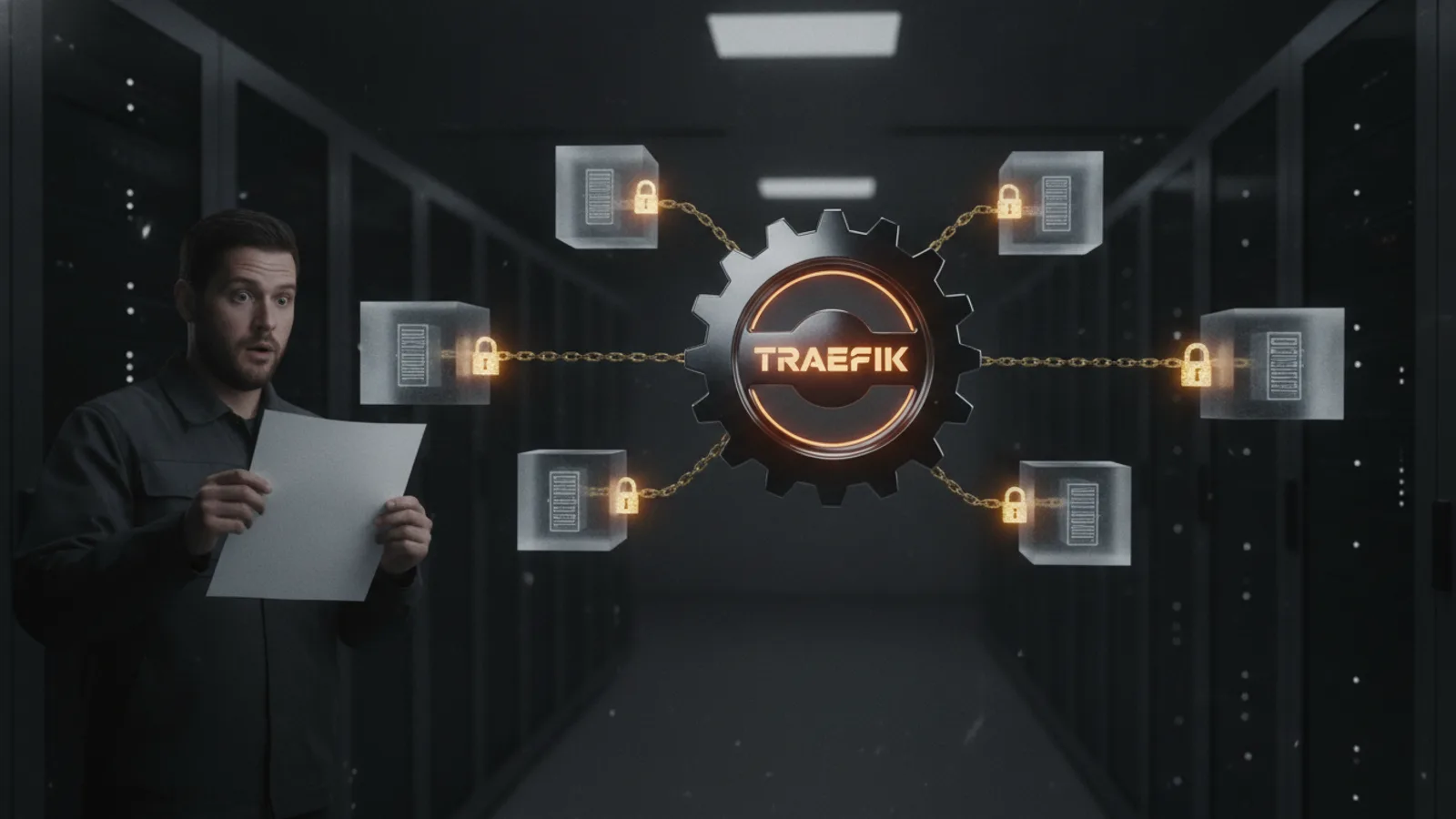
Traefik doesn’t get configured — it discovers your Docker containers and gives them HTTPS before you lift a finger

Traefik v3.7.0, released May 5 2026, takes the reverse proxy to its logical conclusion: it reads your Docker container labels, provisions Let’s Encrypt certificates, and routes traffic without a single static config file. If Nginx Proxy Manager got your foot in the door, Traefik is the next step — the one where you stop configuring your reverse proxy and let it discover your services for you.

Forgejo Runs Your Code Forge on 100 MB of RAM and Nobody Owns It

Forgejo shipped version 16.0 on July 16, 2026, three and a half years after the community fork from Gitea. A single 100 MB Go binary replaces both GitHub and GitLab on the cheapest VPS money can buy, with GitHub Actions-compatible CI/CD and governance locked under a non-profit foundation.

Jellyfin Is the Netflix Alternative That Answers to No One

On April 29, 2025, Plex doubled its lifetime price to $249.99 and killed free remote streaming. One year later, Jellyfin has crossed 50,000 GitHub stars, 360 million Docker pulls, and 51% market share among self-hosters. If you own a server and a media collection, paying to stream it no longer makes sense.

Vaultwarden replaces Bitwarden everywhere you self-host your passwords

Vaultwarden 1.37.0, released July 24, 2026, is a complete Rust rewrite of the Bitwarden server that sips 50 MB of RAM while the official server gulps 2 GB. If your passwords run on your own hardware, you have exactly zero rational reasons left to use the official Bitwarden server.

Type at least two characters.

navigate open esc dismiss