
Unraid and 45HomeLab’s X4 sells a turnkey home server for $1,199
Unraid and 45HomeLab have opened pre-orders for the X4, a pre-assembled four-bay home server shipped with Unraid OS pre-installed, starting at $1,199 and delivering in October 2026. For anyone torn between building their own box and buying a locked-down NAS, that price defines a third path — provided you read the trade-offs.
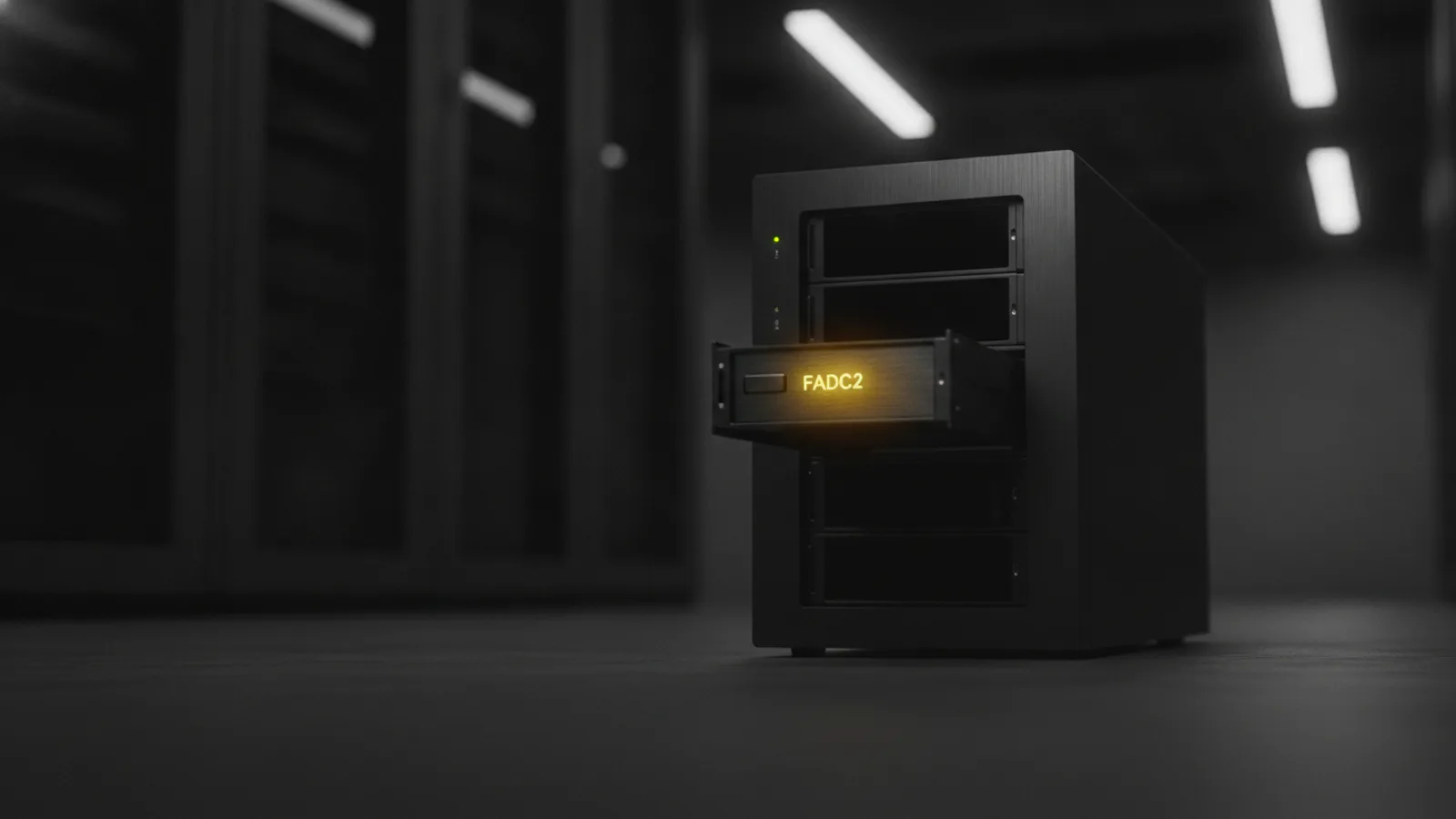
March 24, 2026. Lime Technology (the company behind Unraid) and 45HomeLab announce a joint line of pre-assembled servers, the Signature Series. September 2026. Pre-orders open for the X4, the line’s second model, with an entry price of $1,199. October 2026. The first units begin shipping. In six months, the turnkey home server — hardware and software engineered together and sold as a product — went from announcement to catalog. The signal is bigger than one machine: self-hosting is becoming a consumer product category.
What is inside the machine
The X4 is a compact chassis with four 3.5-inch bays, tool-free and cable-free: drives slide in from the top and connect directly to a backplane. The system runs an Intel Core Ultra 5 225 — ten cores, six performance and four efficiency — on an ASRock B860I WiFi board in the Mini-ITX form factor. Memory starts at 8 GB of non-ECC DDR5, expandable to 64 GB, and system storage is a 500 GB NVMe SSD with a second M.2 slot free.
The rest of the spec reads like a parts list chosen for silence: a 300 W SilverStone SFX power supply, a Thermalright AXP-90 X53 cooler, and two 120 mm Arctic P12 Pro fans. The whole thing measures 13.5 × 5.7 × 11.7 inches, weighs 17 lb without drives, and claims 36 dBA under full load. Networking is 2.5 GbE standard, with 10 GbE or Wi-Fi 6E as options, plus a free PCIe slot for a graphics card — an NVIDIA GeForce RTX 5060 is offered — or a faster network controller.
Every X4 ships with an Unraid Starter license pre-installed, bound to a TPM module, with the option to move to a Lifetime license. The warranty is one year, carried by 45HomeLab, which assembles in the United States (Wilmington) and Canada (Nova Scotia).
Why this is a turning point, not just a product
For two decades, self-hosting has run on two paths that never crossed. On one side, the tinkerer who assembles a machine part by part, owning compatibility, cabling, and troubleshooting. On the other, the buyer of a closed NAS — Synology, QNAP — who gains simplicity but surrenders control of the software and the upgrade path. The X4 targets the middle: standard, replaceable hardware, an open operating system pre-installed, and a single support channel.
The 45HomeLab pedigree explains the promise. The company comes from the team behind Protocase and 45Drives, which has spent decades designing storage for research labs, governments, and enterprises. The chassis is heavy-gauge steel, fully screw-serviceable, with no proprietary parts: every component — drives, memory, cooling, networking — can be replaced or upgraded. That is the central argument against a branded NAS, whose value decays with software obsolescence as much as with the silicon.
The intended customer is not the enthusiast who loves building, but the person with a problem to solve: a photographer running out of space, a family pulling photos out of the cloud, a small business that wants shared storage without handing everything to a provider. For them, the X4’s message is “unbox it, turn it on, and organize your files the same afternoon.”
The processor choice is not a detail
The Core Ultra 5 225 was picked for one reason: its Intel Quick Sync iGPU, which handles hardware video transcoding in Plex, Emby, or Jellyfin, plus AV1 encode and decode. For a server whose headline use case is a media library, that is the deciding feature: it avoids buying a dedicated GPU and leaves the PCIe slot free for another upgrade.
It is also a strategic choice. Rather than a server-class ECC chip — as offered by the bigger X15 with its 15 bays, 10 GbE, and Lifetime license — the X4 bets on non-ECC DDR5 to hit a consumer price point. The nuance deserves to be said plainly: for ZFS storage with memory error correction, ECC is recommended. For Unraid’s parity model, which recalculates data on demand across mixed drives, the absence of ECC is a more acceptable compromise — but it is a compromise, not an oversight.
What $1,199 does not buy
The entry price is real, but it should not be read as a total. The four bays ship empty: drives are extra, and that is where the real cost lands. Four 8 to 12 TB drives easily add $800 to $1,500 to the budget, before even considering a Lifetime license (the Starter tier caps the number of attached storage devices), 10 GbE, or a graphics card. The $1,199 X4 is a solid base, not a complete configuration.
An honest comparison therefore runs on three axes. Against DIY, the X4 loses on raw price — at equivalent components, a patient builder saves several hundred dollars — but wins on time, component validation, and support. Against an equivalent Synology or QNAP NAS, it wins on openness (Unraid, Docker, virtual machines, no dependence on a proprietary app store) and repairability, but loses on the software polish of a closed ecosystem and on warranty (one year versus often three or five). Against the X15, it loses on bays, ECC, and license, but wins on price and footprint.
The Starter license, and what it caps
The X4 ships with an Unraid Starter license, and the difference from the Lifetime license is not cosmetic. The Starter tier limits the number of storage devices you can attach: past the cap, you pay to go further. For a four-bay box — plus the boot NVMe and a second M.2 slot — the Starter tier is enough at launch, but a user who adds a cache SSD, a second NVMe, or an external drive can hit the limit faster than expected. The Lifetime license is paid once and removes the cap; the real buying question is not “which license is included” but “at what point does the Starter become a wall.”
That license choice also says something about the X4’s software positioning. Unraid does not work like a traditional NAS: instead of a striped RAID where all drives must match, it pools mixed-size drives behind one or two parity disks and spins up only the disks a read actually needs. It is a more forgiving model for someone reusing heterogeneous drives, and less demanding of ECC than ZFS — at the cost of a slower parity rebuild than strict mirroring. TrueNAS (ZFS) remains more rigorous about data integrity, and OpenMediaVault lighter and free. The X4 does not invent this debate: it picks a side — Unraid — and sells it pre-installed.
Verdict
If you want an Unraid server without assembling one and without researching compatibility, the X4 is a serious proposition: validated hardware, pre-installed software, standard components, and shared support from two established companies. If your priority is budget, build it yourself — you will pay less, on the condition that you value your own time at zero. If you want the longest warranty and a closed interface with no surprises, stay with Synology or QNAP. If you are storing critical data and want ECC, look at the X15 or a DIY build on a server platform. The real news is not the price: it is that an open, turnkey home server now exists as a product, with a pre-order flow, configurable options, and a shipping date. Self-hosting has stopped being an insider’s hobby and become something you can buy.