
D-Link confirms unpatched zero-days in the DDP protocol of its DGS-3130 switches
On November 6, 2026, D-Link published mitigations — but no fix — for several unpatched flaws in the DDP discovery protocol that affect its DGS-3130 managed stackable switches, and has not yet assigned any CVE IDs. Disable DDP, remove default SNMP communities, and confine SSH, the web UI, and SNMP to an isolated management network.
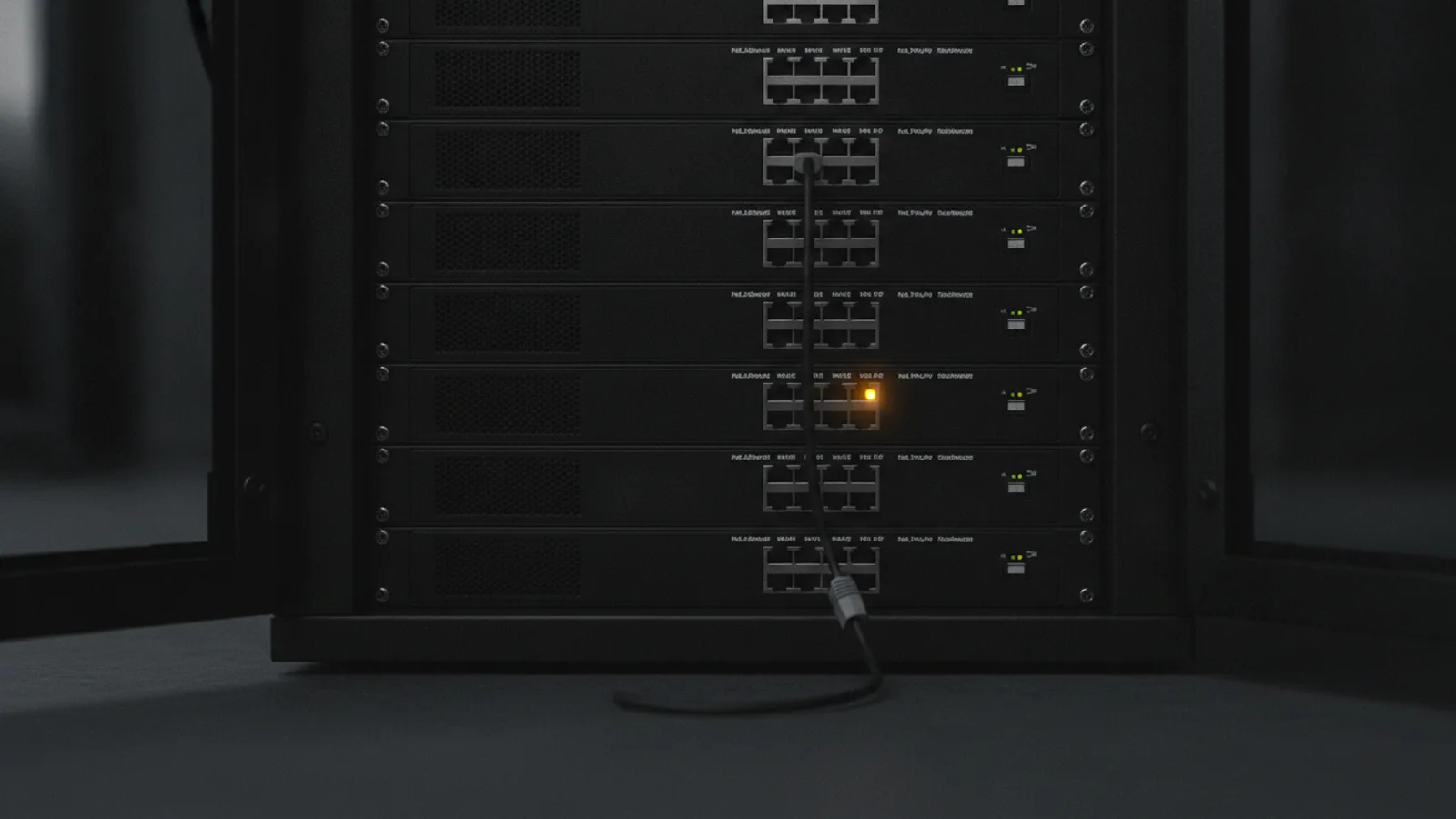
November 6, 2026. D-Link publishes mitigations for several unpatched security flaws affecting its DGS-3130 managed stackable switches. No CVEs. The vendor has not yet assigned any CVE identifiers to the flaws, nor shipped a fixed firmware. DDP. The defects live in the D-Link Discovery Protocol, the vendor’s proprietary discovery protocol. Why it matters: an attacker already on the LAN can read switch data, change its configuration, steal SNMP communities, or force resets — and for now there are only workarounds, not a patch.
Flaws in a discovery protocol, not in the IP stack
The reported vulnerabilities touch the D-Link Discovery Protocol (DDP) plus, in D-Link’s wording, “certain components of the device’s firmware security architecture.” DDP handles discovery and initial management of the vendor’s devices — an in-house answer to neighbor protocols like LLDP or CDP, enabled by default on many units.
The flaws span three functions of the protocol: authentication, access control, and information handling. In practice, successful exploitation lets an attacker with access to the affected network:
- read sensitive device data;
- perform unauthorized administrative operations;
- modify configuration or credentials;
- leak SNMP community strings;
- cause service disruptions or factory resets.
D-Link has not disclosed the exact number of flaws, their technical mechanism, or their exploitation complexity. What is known: they were found by Giresh Kumar Enugu, a network engineer at Spectrum Community Solutions, and they affect multiple firmware versions of the DGS-3130-30TS, a model with multi-gigabit uplinks aimed at SMBs and metro Ethernet deployments.
The vendor says it is still investigating the impact on other switching platforms and on firmware security mechanisms, including the SSH service security configuration, underlying operating-system credentials, firmware encryption, and embedded cryptographic keys. That last mention is heavy: a flaw in embedded key handling is not necessarily fixable by swapping a binary.
A discovery protocol exposed by default
To grasp the reach, it helps to know what DDP actually does. It is a multicast protocol that lets a D-Link console discover the vendor’s devices on a segment and bootstrap their initial configuration — address assignment, bring-up, monitoring. Built for install convenience, it listens constantly on the interface, without strong authentication, and usually stays enabled out of the box after rollout.
A discovery protocol is exactly the kind of surface that never gets audited. Teams harden SSH, change SNMP communities, segment the management VLAN — and leave DDP answering any host on the segment. That is the asymmetry the flaws exploit: the vector is not the IP stack or the switch’s control plane, but an auxiliary service no security policy ever names.
The stackable nature of the DGS-3130 makes it worse. These switches link together through a stacking backplane to form a single logical stack, managed as one device. An attacker who compromises one member of the stack reaches the control plane of the whole stack — configuration, MAC tables, VLANs, QoS. Compromising a single weak link amounts to compromising the entire chassis, a ring topology typical of metro deployments.
An exploitation model that already assumes LAN presence
The reassuring part — relatively — is the threat model. The attacker must already have network access to the segment where the switch sits. This is not a flaw reachable from the internet through the firewall, but a lateral-movement or compromised-endpoint scenario that turns against the switching fabric.
That does not reduce the severity. A core or distribution switch is a privileged observation point: whoever controls it can capture traffic, redirect flows, inject phantom devices, or cut the network. The theft of SNMP communities is especially worrying, because these strings — still frequently set to public or private — authenticate the remote monitoring and configuration of an entire estate.
That D-Link asks administrators to disable DDP to remove “the primary known attack vector” confirms the protocol is reachable on the segment and is the entry point. A discovery protocol should never be an execution vector; here, it is.
What D-Link recommends, absent a patch
With no fixed firmware in sight, D-Link’s answer is a list of mitigations, to apply immediately on any production DGS-3130-30TS:
- disable DDP on every exposed device;
- remove default or unnecessary SNMP community strings;
- restrict SSH, the web UI, and SNMP to an isolated management network and designated admin hosts;
- keep offline backups of switch configurations;
- watch the logs for unexpected configuration changes, unprompted reboots, or factory resets.
# Disable the D-Link Discovery Protocol (DDP) — DGS-3130 CLI
# (the exact command label varies by firmware version;
#  check your build's official documentation)
disable ddp

# Remove default SNMP communities before recreating read-only ones
delete snmp community public
delete snmp community private

# Confine management: allow admin access only from the management VLAN
create snmp community "read-only" ro view DefaultView
These measures shrink the surface without closing the hole. As long as the firmware is unfixed, an administrator who leaves DDP enabled and management reachable from the workstation VLAN remains exposed — the mitigation is about segmentation, not denial.
Verifying the change matters as much as making it. A disabled protocol that a later firmware default re-enables, or a switch re-added to the stack with factory settings, is a silent hole. The concrete checks are to confirm DDP no longer answers on the segment, to watch the logs for the four signals D-Link names — unexpected configuration changes, unprompted reboots, factory resets, and new management sessions from unexpected hosts — and to keep the offline configuration backup current, since a factory-reset switch is otherwise rebuilt by hand.
A recurring pattern at D-Link
This alert is not an isolated episode. In September 2026, D-Link had already warned of a maximum-severity zero-day — CVE-2026-86296 — on its DIR-822A Wi-Fi routers, with a public proof-of-concept and, again, no patch. The pattern repeats: an entry-level network device, a known flaw, no fix, mitigations in the meantime.
What changes here is the class of device. The DIR-822A are consumer routers. The DGS-3130 are managed stackable switches sold to SMBs and metro-Ethernet operators — infrastructure gear, not home edge boxes. An unpatched flaw there costs more, because the device aggregates dozens or hundreds of endpoints.
The lesson outlives D-Link. Any proprietary discovery protocol — DDP, but also CDP, LLDP, NDP, EDP — should be treated as attack surface, not as a commodity. It listens constantly, answers without strong authentication, and often stays enabled by default after rollout. The first hardening move on a switch should be to turn it off unless monitoring explicitly needs it.
Verdict
The DDP zero-days on the DGS-3130 are a segmentation problem, not just a patching one. D-Link promises neither CVEs nor a patch date, and the vendor’s recent record — CVE-2026-86296 left unfixed in September — argues for caution rather than passive waiting.
If you run DGS-3130-30TS switches, disable DDP today, remove default SNMP communities, and cut management off from the workstation VLAN — that is the full mitigation D-Link describes, and it is one CLI session away. If your estate is heterogeneous, start with core and distribution switches — they concentrate traffic observation and SNMP-community theft. If you are in a buying cycle, fold the vendor’s patch cadence into your criteria — an SMB switch whose maker discloses unpatched zero-days twice in three months is a supply-chain risk to price in, not a discount to grab.